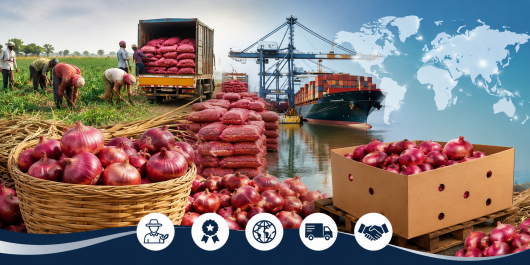
Onions are one of India’s most consistently traded agricultural commodities, and global demand keeps rising year after year. Whether you’re a wholesale buyer in the Middle East, a distributor in Southeast Asia, or a business exploring fresh sourcing options, understanding how onion export from India works can help you make smarter procurement decisions.
India remains one of the largest producers and exporters of onions in the world, backed by favorable growing conditions, diverse onion varieties, and an established export infrastructure. But successful sourcing isn’t just about placing an order , it depends on understanding quality standards, seasonal availability, and the export process itself.
This guide breaks down everything you need to know about onion export from India, from major markets to quality benchmarks and the step-by-step export journey.
India’s onion industry benefits from a rare combination of factors: multiple growing seasons across different states, a wide variety of onion types, and decades of export experience.
States like Maharashtra, Karnataka, Gujarat, Madhya Pradesh, and Andhra Pradesh contribute heavily to India’s onion production, allowing for near year-round harvest cycles. This means exporters can often fulfill orders even outside a single region’s peak season by sourcing from other growing belts.
India also produces several onion varieties suited to different markets:
This variety gives international buyers flexibility depending on their culinary and commercial requirements.
India exports onions to a wide range of countries, with demand particularly strong across:
Middle East: UAE, Saudi Arabia, Qatar, Oman, Kuwait, and Bahrain remain some of the largest importers of Indian onions, driven by high consumption and limited local production capacity.
Southeast Asia: Malaysia, Sri Lanka, and Bangladesh regularly import Indian onions to meet domestic demand gaps.
South Asia: Nepal and Bangladesh are consistent buyers due to geographic proximity and lower logistics costs.
Other regions: Onions from India also reach parts of Europe and Africa, though volumes here are typically smaller compared to Middle Eastern and Asian markets.
Buyers in these regions often choose Indian onions for a combination of competitive pricing, consistent supply volume, and the availability of multiple onion grades to suit different end uses, from retail packaging to bulk food service.
Quality control is one of the most critical parts of the onion export process. International buyers expect onions that meet specific size, color, and shelf-life standards, and reputable exporters build quality checks into every stage of the supply chain.
Size grading: Onions are typically graded by diameter (such as 40-60mm, 60-80mm, or 80mm+), since different markets and use cases require different sizes.
Moisture and dryness: Proper curing and drying after harvest reduces moisture content, which directly affects shelf life during long shipping durations.
Skin quality: Firm, unbroken outer skin with minimal blemishes is a key visual and quality marker that buyers inspect closely.
Uniformity: Consistent size and color within a shipment reflects careful sorting and adds to perceived product quality.
Packaging standards: Mesh bags, jute bags, or export-grade cartons are used depending on shipment size and destination country requirements, helping maintain airflow and reduce spoilage during transit.
Exporters who follow strict quality protocols, from farm-level sourcing to pre-shipment inspection, are generally more reliable for repeat, long-term buyers.
Understanding the export process helps buyers know what to expect and helps new exporters navigate compliance requirements correctly.
A smooth export process depends heavily on the exporter’s experience with documentation, logistics coordination, and compliance, since delays at any stage can affect shelf life and buyer satisfaction.
Onion export pricing from India isn’t fixed and depends on several variables:
Working with an established exporter who understands these variables can help buyers plan procurement more predictably, especially for recurring or long-term supply agreements.
Choosing the right export partner directly impacts product quality, delivery timelines, and business reliability. Key things to evaluate include:
A dependable export partner reduces risk for international buyers and builds the foundation for long-term sourcing relationships.
Onion export from India continues to be a reliable and growing trade, supported by diverse growing regions, multiple onion varieties, and established international demand. For buyers, understanding quality benchmarks and the export process helps ensure smoother procurement and consistent supply. For exporters, maintaining strict quality control and transparent processes builds the trust needed for long-term international partnerships.
Whether you’re sourcing onions for retail distribution, food service, or wholesale trade, working with an experienced and quality-focused export partner makes all the difference in getting fresh, well-graded produce delivered reliably to your market. At Jesvil Corporation, we specialize in exporting premium-grade onions from India with strict quality control, transparent documentation, and reliable logistics for international buyers. Get in touch with our team to discuss your sourcing requirements.
Which countries import the most onions from India?
The UAE, Saudi Arabia, Malaysia, Sri Lanka, Bangladesh, and Nepal are among the largest importers of onions from India, driven by strong demand and limited local production in these regions.
What onion varieties does India export?
India exports several varieties, including red onions (the most common export type), white onions, small pearl onions used for pickling, and specialty varieties like Bangalore Rose onions.
What size grading is used for onion exports?
Onions are typically graded by diameter, commonly in ranges like 40-60mm, 60-80mm, and 80mm and above, depending on buyer and market requirements.
What documents are required to export onions from India?
Standard documentation includes a commercial invoice, packing list, certificate of origin, phytosanitary certificate, and bill of lading, with additional certifications sometimes required based on the destination country.
How are onions packed for export from India?
Onions are commonly packed in mesh bags of 25kg or 50kg for bulk shipments, though custom packaging can be arranged depending on buyer specifications and order size.
What affects the price of onion exports from India?
Pricing depends on seasonal supply, onion variety and grade, shipping method, order volume, and destination-specific import duties and logistics costs.

 Call :
 Email :