If you are planning Indian banana export, the first question is rarely price. It is whether the fruit will arrive green, firm and ready to ripen. Bananas are sensitive, so packing and shipping decide quality as much as farming does. This guide explains how bananas are packed and shipped for export from India, from harvest and cartons to cold chain and transit, in clear steps buyers can verify.
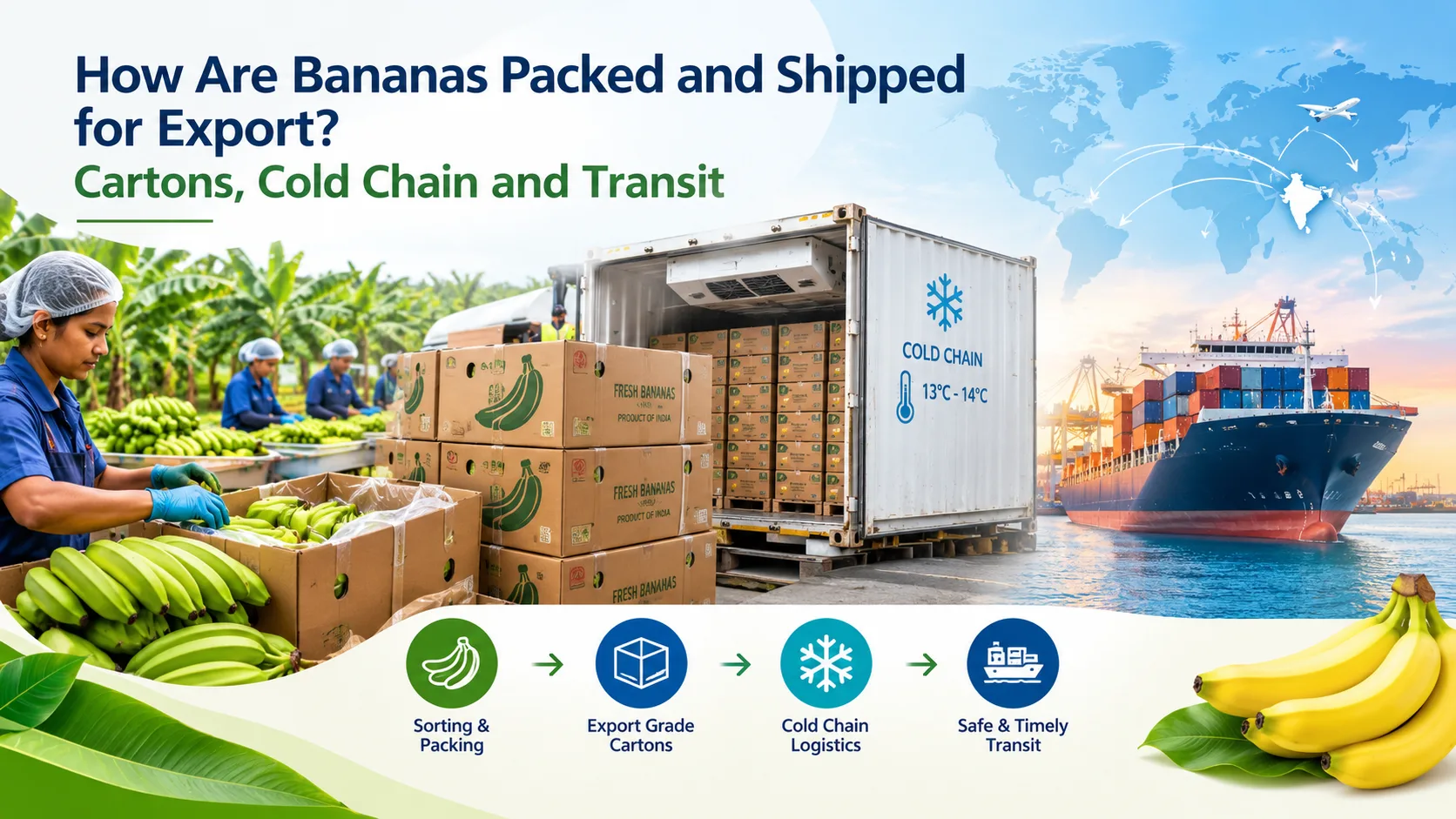
For Indian banana export, bananas are harvested green, washed, graded and packed in ventilated cartons. They are pre-cooled and loaded into refrigerated (reefer) containers kept at about 13 to 14°C, then shipped by sea with documents such as the commercial invoice, packing list, certificate of origin, phytosanitary certificate and bill of lading. At the destination, the fruit is ripened in controlled rooms before it reaches shelves.
India is one of the leading banana producers and exporters in the world. But growing good fruit is only half the job. A banana is a living product. It keeps breathing and ripening after harvest, and it bruises easily.
Poor packing causes crushed fingers, latex stains and early ripening. A broken cold chain can cause chilling injury or uneven colour. For an importer, that means rejected pallets and lost margin.
That is why serious buyers look beyond the farm and ask how an exporter handles every step between harvest and port. The sections below follow the journey in order.
Export bananas are never picked ripe. They are cut while still green and mature, so they can survive days or weeks in transit and ripen later under control.
Good exporters work with farms that follow clear harvest practices:
Cavendish bananas, also sold as G9, are the most common export variety because of their uniform size, sweet taste and reliable shelf life. Jesvil’s G9 banana is a good example: firm, uniformly ripened fruit that is carefully cultivated and handpicked.
Once bunches reach the packing area, the fruit goes through several quick checks:
Grading matters because buyers order by specification. Uniform fingers look better on shelves and ripen more evenly. In Indian banana export, a consistent grade is one of the clearest signs of a reliable supplier.
The carton is the first line of defence. Export banana cartons are usually ventilated corrugated boxes designed to hold the fruit firmly without crushing it. Carton weight and size vary by market, and they are agreed per order, so always confirm the exact specification before you place an order.
When reviewing a supplier’s cartons, ask about:
A well-packed carton protects the fruit for the whole journey. A weak one can ruin an entire container, so do not treat packaging as a minor detail.
Cold chain is the backbone of Indian banana export. Bananas are packed, then cooled quickly so the fruit stops generating heat and the ripening process slows down.
Here is how a good cold chain works:
The temperature range matters. Bananas that are too warm ripen too soon. Bananas that get too cold suffer chilling injury, which shows up as dull, greyish skin and poor ripening. This is why exporters use reliable reefer equipment and check settings before every shipment.
Loading is more than stacking boxes. Cartons are palletised or floor-loaded in a pattern that lets air move through the load. The container is pre-cooled, sealed and tracked until it reaches port.
Most Indian banana export moves by sea in reefer containers, because it balances cost and quality for bulk orders. Transit time depends on the destination, shipping line, port and season. These ranges are only indicative:
| Destination Region | Typical Transit by Sea |
| Middle East (e.g. UAE) | Around one to two weeks |
| Australia | Around three to four weeks |
| Canada | Around four to six weeks or more |
Always confirm the schedule with your exporter, because delays at ports can affect ripening plans. Jesvil’s banana export services cover fresh G9 and Cavendish bananas for buyers in markets such as the UAE, Australia and Canada.
Paperwork is part of the shipment. Buyers should expect their exporter to prepare documents such as:
Fresh bananas are generally classified under HS code 0803, though your customs agent should confirm the exact code for your country. Requirements differ by destination, so check import rules with your customs broker early.
Bananas arrive green. Importers then ripen them in controlled rooms using ethylene gas, with temperature and humidity managed carefully. The result is evenly coloured, ready-to-sell fruit.
This is why the cold chain and cartons matter so much. If the fruit starts ripening in the container, the importer loses control of timing and quality.
Jesvil Corporation is an agri-export company based in Kerala that supplies fresh, high-quality bananas to international buyers. Buyers value the combination of:
If you want specifications, minimum order quantity and lead time in writing, the Jesvil team can share them against your requirement.
The banana plant offers more than fruit. After harvest, the pseudo-stem is often discarded as farm waste, yet it can be turned into fiber for eco-friendly goods. Jesvil also offers banana fiber products such as handcrafted lamps, wall art, baskets and decor pieces. They are a good fit for buyers looking for sustainable, biodegradable alternatives to synthetic materials, and they can be shipped together with other Jesvil products.
Before confirming an Indian banana export order, make sure you have clear answers on:
Packing and shipping are what turn good fruit into a good delivery. If you are looking for a reliable partner for Indian banana export, contact Jesvil Corporation with your required variety, quantity and destination. Call or WhatsApp +91 963 399 9904 or email sales@jesvil.co.in to get a quote.
Bananas are harvested green, washed, graded and packed as clusters in ventilated corrugated cartons. Liners or polybags protect the fruit, and cartons are labelled with variety, grade and weight before pre-cooling.
Bananas are generally shipped in reefer containers at about 13 to 14°C. Warmer conditions cause early ripening, while colder conditions can cause chilling injury, so a steady temperature is essential.
Most Indian banana export moves by sea in refrigerated containers. The fruit is pre-cooled, loaded in a way that allows airflow, sealed and tracked until it reaches the destination port.
Transit time depends on the route, shipping line and season. As a rough guide, the Middle East takes around one to two weeks, while Australia and Canada take several weeks. Confirm the schedule with your exporter.
Buyers typically need a commercial invoice, packing list, certificate of origin, phytosanitary certificate and bill of lading. Requirements vary by country, so check with your customs agent.
Cavendish, also called G9, is the most popular export variety thanks to its uniform size, sweet taste and dependable shelf life. It suits long transit and controlled ripening.
Call or WhatsApp +91 963 399 9904, email sales@jesvil.co.in, or use the Get a Quote form on jesvil.co.in with your variety, quantity and destination.

 Call :
 Email :