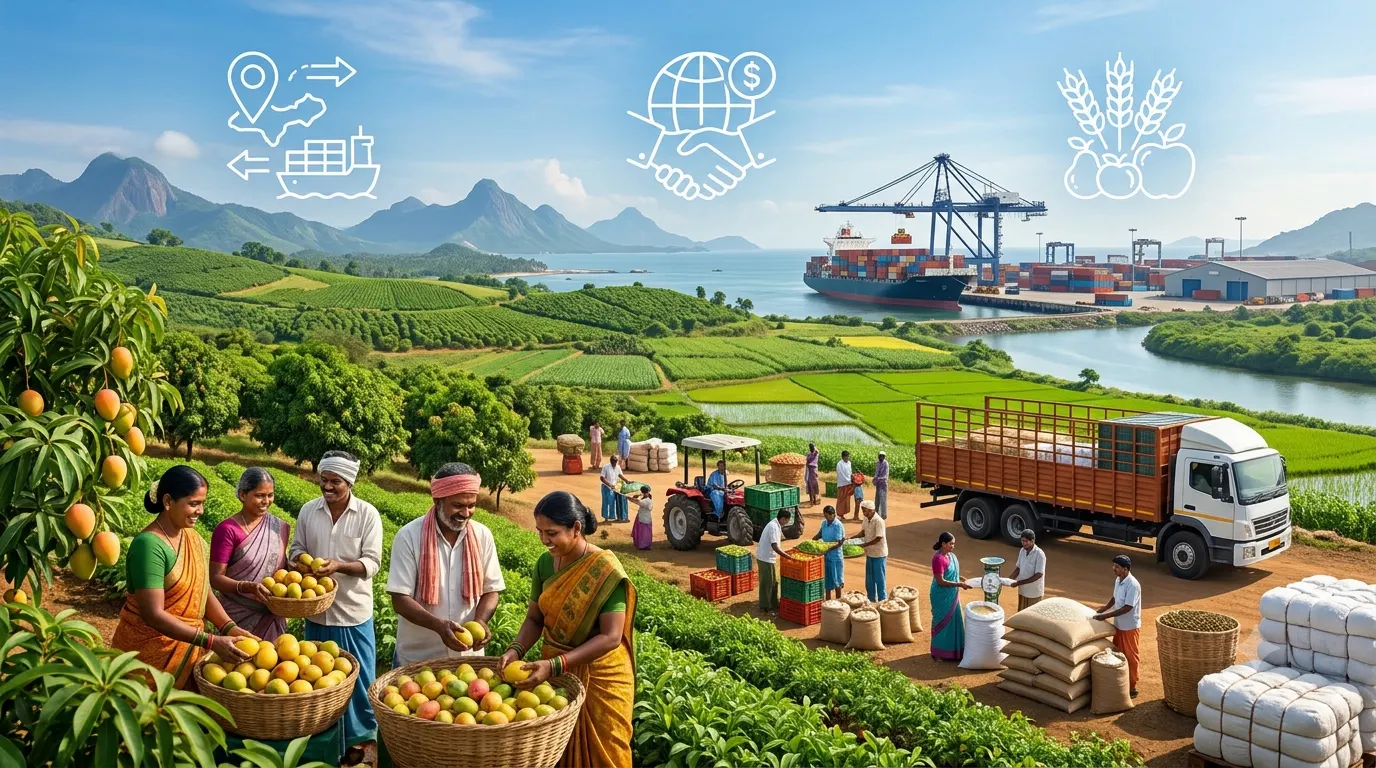

Vegetables export from India works best when the buyer knows where the produce was grown and what went into it. Importers in the EU, Australia, the Middle East, and the Indian Ocean region now ask for more than a price. They ask for farm origin, residue control, clean paperwork, and packaging that survives the journey.
At Jesvil Corporation, we grow on our own farm and work with contract farming partners under controlled residue practices. We then pack and ship from Kerala. This guide explains how vegetables export from India works, what strict markets check, and what our latest shipments looked like.
Vegetables export from India is the process of growing, grading, packing, documenting, and shipping fresh produce from Indian farms to buyers abroad. It covers staples such as onion, garlic, and ginger, along with beetroot, broccoli, and other fresh vegetables.
An exporter handles more than the shipment. The exporter manages farm sourcing, quality checks, packaging, certificates, and the cold chain or ventilated transport that keeps produce fresh until it reaches the importer.
India has a wide growing calendar, varied agro-climatic zones, and strong farming skills in staple crops. For importers, this means steady supply, a broad product range, and competitive pricing.
Buyers also have a practical reason: shipping time. India sits close to the Middle East, South Asia, and the Indian Ocean, and has established sea and air routes to Europe and Australia.
Price alone does not win repeat orders, though. Buyers return to exporters who deliver consistent size, clean documents, and produce that passes inspection on arrival. That is why farm-level control has become the real differentiator in vegetables export from India.
Controlled residue farming means managing every crop input so that pesticide and chemical residues on the harvested vegetables stay within the limits of the destination market.
Those limits are called maximum residue limits (MRLs). The EU sets MRLs under Regulation (EC) No 396/2005, and Australia applies its own residue standards and biosecurity checks. A vegetable that is fine in one market can fail in another, so the target is set by where the produce is going.
Testing a finished lot is not enough, because a failed test at the port is expensive and cannot be undone. Controlled residue farming moves the control upstream, to the field.
Our model combines our own farm with contract farming and contract manufacturing partners who follow our protocols. This gives us control over what happens before harvest.
The result is vegetables export from India that a buyer in Europe or Australia can trace, question, and trust.
Each market asks for something different. Here is a simple view of what matters most.
| Market | What buyers focus on |
|---|---|
| European Union | Strict MRL compliance, traceability, clear labelling |
| Australia | Biosecurity rules, import conditions per product, clean consignments |
| Middle East | Freshness, size grading, fast transit |
| Maldives and Indian Ocean | Reliable schedules, correct labelling, carton strength |
Always check the current import conditions for your product and country before ordering, because rules and permitted products change. Australia, for example, publishes product-specific import conditions that need to be confirmed first.
A good exporter will tell you what a market requires before you place the order, not after the cargo arrives.
This month, our team packed and dispatched fresh vegetables from Kerala to the Republic of Maldives. Each carton carries the exporter’s details, the importer’s details, the FSSAI licence number, the net weight, and a “Product from India” mark, so the consignment is easy to identify at every step.
| Product | Pack | Exported by | Imported by | Destination |
|---|---|---|---|---|
| Fresh garlic | 10 kg net | Jesvil Corporation Private Limited, Kerala | Nordex Trade Private Limited | Male, Republic of Maldives |
| Fresh onion | 25 kg net | Jesvil Corporation Private Limited, Kerala | Nordex Trade Private Limited | Male, Republic of Maldives |
| Fresh ginger | 10 kg net, 11 kg gross | Jesvil Corporation Private Limited, Kerala | The Hawks Private Limited | Male, Republic of Maldives |
The ginger cartons are ventilated, so the produce can breathe and moisture does not build up during transit. The cartons were stacked and loaded into the container with clear branding on every face, which helps the importer count and inspect the load quickly on arrival.
Shipments like these show what vegetables export from India looks like in practice: correct labels, the right pack size, and a documented route from farm to port.
Exact requirements depend on the product and the destination, but most consignments need:
For the EU and Australia, ask your exporter to share lab reports and traceability records at the quoting stage. A serious exporter will have them ready.
Use this checklist before you commit to a supplier:
An exporter who answers all six with evidence is worth shortlisting. One who answers with promises only is not.
If you are looking for vegetables export from India with farm-level control and clear documentation, we can help. Tell us your product, quantity, destination, and packing preference, and our team will respond with a quote and the documents your market needs.
Contact: sales@jesvil.co.in | +91 96339 99904
Explore our vegetables exporters in India page and our organic export from India range.
It is the process of growing, grading, packing, documenting, and shipping fresh Indian vegetables to overseas buyers. A good exporter also manages quality, residue control, and shipping paperwork.
Common exports include onion, garlic, ginger, beetroot, and broccoli, along with other fresh vegetables. Availability depends on season and destination rules.
Most shipments need an IEC, FSSAI-compliant labelling, a phytosanitary certificate, a certificate of origin, an invoice, a packing list, and transport documents. Strict markets may also ask for residue test reports.
We manage residues at the farm: approved inputs, recorded spray schedules, pre-harvest intervals, lot-wise traceability, and testing before dispatch against the destination’s limits.
We supply buyers in the EU, Australia, the Middle East, and other regions. This month’s shipments of garlic, onion, and ginger went to the Maldives.
Share your product, quantity, destination, and packing needs at sales@jesvil.co.in or call +91 96339 99904. We will reply with pricing and the documents your market requires.

 Call :
 Email :